Friday, August 21, 2009

New review of From This Place in JazzTimes!


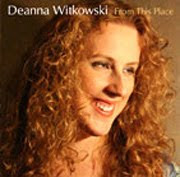
Yesterday I happily found the new issue of JazzTimes in my mailbox. The magazine had ceased publication for a couple of months, and I was just happy to see it back in circulation. Flipping through its pages while on the subway, I thought, "I wonder if they've reviewed From This Place" -- and then I found my CD cover (with a review) on page 73! Since the review has not yet been posted on their website, I'm posting it here in its entirety.

Deanna Witkowski- From This Place- by Christopher Loudon (Aug/Sept JazzTimes)

Following the hallowed path of Mary Lou Williams, pianist and vocalist Deanna Witkowski devotes her fourth album exclusively to the blending of jazz and liturgy, drawing on scripture, the Mass, 19th-century poetry and original verses to build this expansive house of musical worship. Four notes into saxophonist Donny McCaslin's bluesy intro to "Let My Prayer Rise" it becomes evident how invigorating this marriage of secular and spiritual will be. With the slightly scorched purity of Witkowski's vocals (and the angelic virtuosity of her playing) as the central pillar, McCaslin, bassist John Patitucci and drummer Scott Latzky circle like impish altar boys, never irreverent yet eager to splash her white lace with vibrant daubs.

The cornerstone of From This Place is a four-part extraction from the evening jazz mass Witkowski wrote a decade ago for Manhattan's All Angels' Church (where she served as music director). For two segments, she forms a glorious union with vocalists Peter Eldridge, Kate McGarry and Laila Biali to create what might fairly be called the Holy New York Voices. McGarry and Biali later return for the soaring a cappella "Never Before," which tells of the revelation to Mary that she will bear the Christ child. But perhaps most praiseworthy is the tracing of Mary Magdelene's Easter morning epiphany on the title track, begun in cold shadows then opening up like a glorious sunrise.

Thursday, July 2, 2009

"take the dimness of my soul away"

I'm doing some last-minute work on a new setting of another nineteenth-century hymn text for my quartet to play this Sunday at New York's Saint Peter's Church. This particular text was written by an Irish poet named George Croly. There are so many vibrant images in Croly's text that I decided to try to write some new music to attempt to get inside the lyric.

Usually when I set text, I spend some time meditating on phrases that stir something in me. The meditation can involve sitting down at my bedroom desk and seeing what images come to mind from a particular word or phrase, or sitting at the piano and improvising chords/melodies to the text, or walking down 42nd Street and having the text come to mind as I encounter the city. One verse in particular in Croly's poem holds power for me:

I ask no dream, no prophet ecstasies,
no sudden rending of the veil of clay,
no angel visitant, no opening skies,
but take the dimness of my soul away.
(emphasis mine)

What does it mean for my soul to be dim? If I really experience my life from my soul (and not just with my mind or my body), then in some respect I am "seeing" my life from my soul. Perhaps my eyesight becomes diminished when I expect the Divine to speak only through "extraordinary" events: the "opening skies," the "dream," the "prophet ecstasies." If God can take the dimness of my soul away, perhaps I can recognize God in an inner stillness, even in the midst of a chaotic day.

Many mornings, I ask God to help me to feel God's presence during the day. But usually the prayer is more of a reminder for myself, to ask for help so that I can be aware of God being as close- closer, even- than my own heartbeat.

God, please take the dimness of my soul away.


Monday, April 6, 2009

New CD (April 7), NPR interview (April 12) and Easter!


April is a great month for new beginnings...I'm looking forward to Easter this year even more than in previous years for a couple of reasons. One is that the night before Easter, I'll be received into the Catholic church. The other is that on Easter morning, my new sacred jazz recording, From This Place, will get a big boost with my interview on National Public Radio's Weekend Edition Sunday! I'm going to be celebrating all weekend.Italic
If you'd like to check out the interview (it will be archived starting at noon on Sunday) or hear clips from the new release, visit my website at http://deannajazz.com.

Here is an excerpt from the liner notes to From This Place which gives a good sense of what the disc is about:

As I write in early December 2008, the Christian church is observing Advent, the first season of the annual liturgical calendar. Advent, according to one dictionary, means an “arrival that has been awaited (especially of something momentous).” This recording, my fourth as a leader and my first focusing specifically on sacred music, is something that I have wanted to make for over seven years.

I want to clarify at the outset that I view all music as sacred, if it is made with intent to heal, uplift, and rejuvenate spirits. One unique aspect of From This Place is its focus on text: from nineteenth-century poets, scripture, the Mass, and occasionally, my original verses. My journey towards creating this music and working with text had its impetus in a move from Chicago to New York City eleven years ago.

I arrived in New York having accepted a fulltime position as music director of All Angels’ Church on Manhattan’s Upper West Side. During my tenure at All Angels’, I composed the genesis of two jazz masses (one present here) and wrote musical resettings of old hymn texts (I Heard the Voice of Jesus Say, Pass Me Not, Take My Life and Let It Be) as well as occasional lyrics and music (Never Before). I found that I loved having a service for which I could write new settings of text that was either said or sung each week. It reminded me of Bach’s time, when the church was a patron of the arts.

In 2000, several months after I left All Angels’, I started to wonder if the music I had composed for services could be used in other houses of worship. I began to build relationships with churches in the hopes that, in addition to playing my instrumental jazz in more traditional jazz venues, I could present my sacred music in the context of worship.

To my delight, in every church in which I have performed, both regular churchgoers and clergy have responded with resounding support. I feel that I am in the company of Mary Lou Williams, the innovative pianist/composer who wrote liturgical jazz in her later decades and brought her music to churches and schools all over the country. To see myself in a tradition and yet breaking new ground is awe-inspiring and also a bit scary at times. But the fact that so many people have shared with me how this music has impacted the way they experience centuries-old text, much of which they may have heard or spoken week in and week out for years (or never heard at all), has confirmed that I am on a right path. I invite you to join me in this place where old and new converge to remind us that hope does indeed exist, even in times of fear or uncertainty.

Monday, November 10, 2008

Learning to trust the path...labyrinths...


A couple of weeks ago, I had the honor of being the guest musician for a conference entitled "Being Whole in the Eyes of God" at Stony Point Center, a retreat center about an hour outside of NYC. This particular event's focus was on how churches can be more welcoming and inclusive of people with disabilities. For me, it was also a reminder that all of us share brokenness, whether it is physical or spiritual or emotional-- and that this brokenness is often where we encounter the presence of God. I know that I encountered God's Spirit in this gathering of friends.

While I was at Stony Point, I visited my favorite spot on their property: a stone labyrinth (see photo). One thing I love about labyrinths is that there is only one way to walk, and even though you can't tell how you'll reach the center, and that the path is windy and seems to sometimes take you further away from the center rather than closer to it, you actually trust that you are moving towards an arrival point-- because if you stay on the path, you do indeed make it to the center. This reminds me of a poem by Denise Levertov that I set back in 2004 for Concentus, a women's choir based in Rochester. The poem, "I learned that her name was Proverb," speaks of how everyone we meet, whether we recognize them or not, lead us into our own labyrinths "towards the time and the unknown place where we shall know what it is to arrive."

Right now I feel like I am in a labyrinth trying to get my sacred music CD out, trying to book tours, trying to have mental and emotional rest. I struggle with trusting that I will reach an arrival point. This is why walking labyrinths is so helpful to me- it is a reminder that all I must do is walk on the path that has been given to me and trust that God is leading me. So simple, yet so hard.

Monday, September 15, 2008

I heard the voice…but I changed its music

Last week, I finished mixing my upcoming sacred music recording, From This Place. Three of the pieces are new settings to hymn texts from various nineteenth century writers.

I love the fact that words have potential to become new for us. I think that’s why in so many faith traditions, sacred scriptures are read again and again—we somehow get another chance to become part of the story.

But often, words can become stale, or overused, and their power is diluted. When words are married with music, in order for the words to be more than just words, there has to be a combination of melody, harmony, and text that allows the words to penetrate our spirits in a deeper way than they would if we were just saying them, or reading them.

I love many old hymns, but to be honest, sometimes I find myself loving a particular text more than a particular tune that’s been married to the text. Case in point: an 1846 text by the Scottish hymn writer, Horatius Bonar, called “I Heard the Voice of Jesus Say.” I’ve heard various musical settings of this text, but Bonar’s lyrics jumped out at me as wanting a new setting that would breathe as the “resting place” that is found in the presence of God. Bonar’s first verse reads:

I heard the voice of Jesus say,
“Come unto me and rest;
lay down my weary one,
lay down your head upon my breast.”

I came to Jesus as I was,
so weary, worn, and sad;
I found in Him a resting place,
And He has made me glad.

Each of the three verses speak of hearing God’s voice, and then of responding in some way. I responded by writing a new setting—you can hear the first two verses here.

Tuesday, August 5, 2008

A week of silence and beauty


A week and a half ago, I went on my third silent retreat. This one was a week in length, and was held at the Linwood Spiritual Center in Rhinebeck, NY. One side of the retreat house is where the sisters of St. Ursula live; the other side is for retreatants. The center has gorgeous views of the Hudson River, and I spent time every day walking to a nearby waterfall (see photo).

Many people have asked me why I voluntarily spent seven days in silence, or what on earth I did with all of my time. For myself, I often get caught up in seeing time as an enemy- there's either not enough of it to do the work that I think I have to do, or there's too much of it when I feel alone and want to have the companionship of another person. But the amazing thing is that I have come to experience through silence a sense of God's presence in a deeper way than I normally do when I go to church. I never knew before silent retreats what it meant to rest in God.

I came to Linwood so tired that the first night when I sat in the armchair in my little room, tears came to my eyes as I realized that I was not required to do anything. All I had to do was to try to be open to God's Spirit. Now as I am back in New York City dealing with the day-to-day, I am trying to open myself more to be aware of God's presence all around me.

Our culture does not reward sitting around and not "producing." While I was on retreat, I read a book by the late Jewish theologian, Abraham Joshua Heschel, called The Sabbath. Heschel says that we often equate productivity with goodness (and hence, not being productive is not a good thing). I see this in myself and want to spend more time simply enjoying the presence of God, whether I am looking at a waterfall, sitting at my computer, or spending time with a friend.

Wednesday, July 16, 2008

From This Place

I'm resurrecting this almost unused blog, mainly so that I can give some background for my upcoming sacred jazz recording, From This Place. The title track is a piece that I wrote back in March of 2007 for an Easter jazz vespers at Saint Peter's Church in New York City. I wanted to write something that would be appropriate with the passages for the day. One of the passages was the story of one of Christ's followers, Mary Magdalene. In the story, Mary goes to Christ's tomb three days after he has been crucified. She finds the tomb empty, and meets the risen Christ (who she at first mistakenly identifies as the gardener). Afterwards, she runs to report the news to other followers of Christ.

I wrote "From This Place" as a meditation, wondering how Mary might have felt from the moment she wakes up in the morning and remembers that Christ is dead to the moment she is bewildered at the tomb, to the moment when she recognizes Christ.

Rather than post some of the lyrics sans music, here is a link with a clip from the piece.

For me, this entire recording has been a powerful experience of delving into texts and images. I'm singing on most of the pieces (as opposed to some of my earlier recordings where I primarily play piano), and I have felt like the whole record is an active prayer. If you'd like more information on the recording, or would like to place a pre-order, visit my website.